How to Serve Customers in 100+ Languages Without Translators
🌐 Languages in this article: English, हिन्दी, தமிழ், العربية, Swahili, Français, Español, 日本語
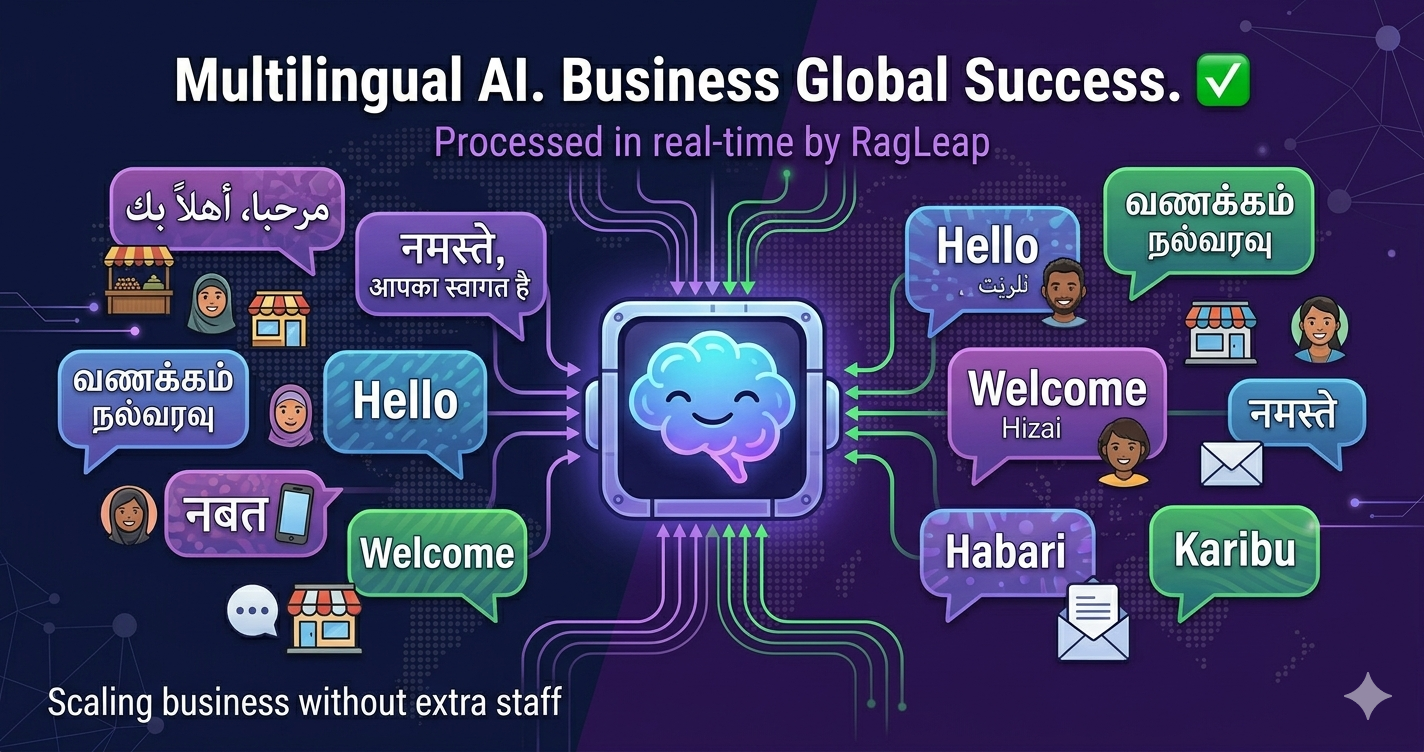
Your customer in Chennai speaks Tamil. Another in Dubai speaks Arabic. One in Lagos speaks pidgin English. One in Japan speaks Japanese. How do you serve them all without hiring an army of translators? The answer: AI that speaks 7000+ languages fluently.
The Language Barrier in Global Business
Globalization promised everyone could do business anywhere. Reality? Language remains the biggest barrier:
- Dubai restaurant: Serves customers in Arabic, English, Hindi, Urdu, Tagalog—needs 3 staff for languages alone
- Indian ecommerce: Customers speak 22+ different Indian languages—impossible to hire for all
- African logistics: Customers across Nigeria speak Yoruba, Igbo, Hausa, pidgin, English—most businesses serve only English speakers
- Global SaaS: Wants to expand to Latin America, but Spanish/Portuguese support costs ₹10L+/month
Traditional solution: Hire multilingual staff costing ₹40K-80K/month per language. For 10 languages? ₹4-8L/month. Impossible for SMEs.
AI solution: One system serving 7000+ languages for ₹5K/month.
How AI Detects and Responds in Any Language
Let's watch RagLeap AI handle a real multilingual scenario:
Scenario: Dubai Boutique (10 AM Tuesday)
Customer 1 (WhatsApp): "مرحباً، هل عندكم فساتين سهرة؟"
RagLeap AI detects: Arabic → Responds in Arabic
RagLeap: "مرحباً! نعم، لدينا مجموعة واسعة من فساتين السهرة. ماهو ميزانيتك؟"
(Hello! Yes, we have wide collection of evening dresses. What's your budget?)
Customer 2 (WhatsApp, 2 minutes later): "Hi, I need party dress for my wife. You have?"
RagLeap AI detects: English → Responds in English
RagLeap: "Hi! Yes, we have beautiful party dresses. What size and color are you looking for?"
Customer 3 (WhatsApp, 5 minutes later): "Bhai, tumhare paas lehenga hai kya?" (Brother, do you have lehengas?)
RagLeap AI detects: Hindi → Responds in Hindi
RagLeap: "हाँ भाई! हमारे पास बहुत सुंदर लहंगे हैं। Wedding के लिए या party के लिए?" (Yes brother! We have beautiful lehengas. For wedding or party?)
Customer 4 (Email, simultaneously): "Magkano ang red gown?" (Tagalog: How much is red gown?)
RagLeap AI detects: Tagalog → Responds in Tagalog
RagLeap: "Magandang araw! Ang mga red gowns ay mula AED 300 hanggang AED 1,500..." (Good day! Red gowns range from AED 300 to AED 1,500...)
All 4 conversations happening simultaneously. Zero human intervention. Each customer feels like they're talking to someone who speaks their language natively.
Serve Global Customers Today
7000+ languages. Auto-detection. No setup needed. Free trial available.
Start Free Trial7000+ Languages: What This Means in Practice
When RagLeap says "7000+ languages", you might think "surely I don't need THAT many". But here's what it actually covers:
Major World Languages (100+ million speakers each):
- English, 中文 (Chinese), हिन्दी (Hindi), Español (Spanish), العربية (Arabic), বাংলা (Bengali), Português, Русский (Russian), 日本語 (Japanese), ਪੰਜਾਬੀ (Punjabi), Deutsche (German), Français (French), తెలుగు (Telugu), मराठी (Marathi), தமிழ் (Tamil), Türkçe (Turkish), ไทย (Thai), ગુજરાતી (Gujarati), Polski (Polish), 한국어 (Korean)...
Regional Indian Languages:
- Hindi, Tamil, Telugu, Bengali, Marathi, Gujarati, Kannada, Malayalam, Odia, Punjabi, Assamese, Urdu, Kashmiri, Sindhi, Sanskrit, Konkani, Nepali, Manipuri, Bodo, Santali, Maithili, Dogri...
- Plus dialects: Bhojpuri, Awadhi, Chhattisgarhi, Haryanvi, Rajasthani, Marwari, Konkani varieties...
Middle Eastern Languages:
- Modern Standard Arabic (MSA), Egyptian Arabic, Gulf Arabic, Levantine Arabic, Moroccan Arabic, Hebrew, Persian/Farsi, Kurdish, Pashto...
African Languages:
- Swahili, Hausa, Yoruba, Igbo, Zulu, Xhosa, Amharic, Somali, Oromo, Shona, Afrikaans, Lingala, Kinyarwanda, Setswana, Nigerian Pidgin...
Southeast Asian Languages:
- Indonesian, Malay, Tagalog, Vietnamese, Burmese, Khmer, Lao, Javanese, Sundanese, Cebuano...
Even Rare/Minority Languages:
- Tulu, Kodava, Gondi, Sorbsih, Frisian, Luxembourgish, Maltese, Macedonian...
Why this matters: You don't choose which languages to support. Customers choose their language, AI responds accordingly. Zero setup needed per language.
Real Regional Example: Code-Switching
Here's what makes AI truly powerful—it handles "code-switching" (mixing languages mid-conversation):
Common in India:
Customer: "Bro, idli dosa irukka? मुझे 2 plate चाहिए।" (Tamil + Hindi mix: "Do you have idli dosa? I need 2 plates.")
RagLeap: "ஆமாம் bro! Idli dosa available. 2 plate ₹240. Delivery address சொல்லுங்க?" (Yes bro! Idli dosa available. 2 plates ₹240. Tell me delivery address?)
AI understands the mix and responds in kind—creating a natural, human-like conversation.
Cultural Localization Beyond Translation
Good multilingual AI doesn't just translate—it localizes. Here's the difference:
Translation (Wrong):
English: "Our special today is beef burger with bacon."
Arabic (translated): "اليوم لدينا برجر لحم البقر مع لحم الخنزير" (Our special is beef burger with pork)
Problem: Pork mentioned to Muslim customer—offensive!
Localization (Right):
English: "Our special today is beef burger with bacon."
Arabic (localized): "اليوم لدينا برجر لحم البقر الخاص" (Our special is beef burger) OR suggests halal alternatives
AI knows context: Don't mention pork to Arabic-speaking customers (likely Muslim)
More localization examples:
- India: Customer asks "Veg hai?" → AI understands means "vegetarian" and highlights veg options
- UAE: During Ramadan → AI adjusts food service messaging ("Breaking fast special...")
- Cultural greetings: "Namaste" in Hindi, "As-salamu alaykum" in Arabic, "Sawubona" in Zulu
- Currency adaptation: Auto-shows prices in INR for Indian customers, AED for UAE, Naira for Nigeria
- Units: Kilometers vs Miles, Celsius vs Fahrenheit based on region
Setting Up Multilingual with RagLeap
Setup required: ZERO.
Seriously. You don't "enable" languages. It's automatic:
- Teach RagLeap your business in YOUR language:
- If you speak Hindi: Teach in Hindi
- If you speak Tamil: Teach in Tamil
- If you speak Arabic: Teach in Arabic
- RagLeap stores information language-agnostically
- Customer messages in their language → AI detects automatically → Responds in that language
- That's it. No configuration. No language selection. Just works.
Example: Chennai Restaurant Owner
Murugan teaches RagLeap in Tamil:
"நான் முருகன் மெஸ் நடத்துகிறேன். இட்லி ₹40, தோசை ₹50, சாப்பாடு ₹120, சிக்கன் பிரியாணி ₹180."
Now RagLeap can serve customers in ANY language:
- Tamil customer → Replies in Tamil
- Hindi tourist → Replies in Hindi
- American visitor → Replies in English
- French backpacker → Replies in French
All from Murugan teaching it ONCE in Tamil. The AI knows the INFORMATION (products, prices), not tied to specific language.
Go Global Without Translators
Teach in your language. Serve in 7000+ languages. Start free.
Get Started FreeEmerging Market Opportunity
Here's the business case for multilingual AI:
India (1.4 billion people):
- Only 10% speak English fluently
- 1.26 billion potential customers speak 22+ OTHER languages
- Opportunity: Serve Hindi/Tamil/Telugu/Bengali speakers = 10x bigger market than English-only
Middle East (450 million people):
- Arabic-first population, but multilingual workforce (Hindi, Urdu, Tagalog, Bengali)
- Businesses serving Arabic + expatriate languages = 3x bigger customer base
Africa (1.4 billion people):
- 2000+ languages spoken across continent
- English/French serve only educated urban elite
- Opportunity: Serve Swahili/Hausa/Yoruba/Zulu = access to mass market
Cost Comparison:
| Option | Monthly Cost | Languages Covered |
|---|---|---|
| Hire 10 multilingual staff | ₹5,00,000 | ~20-30 languages |
| Translation agency | ₹2,00,000+ | 5-10 languages |
| RagLeap AI | ₹5,000 | 7000+ languages |
Best Practices for Multilingual Business
1. Don't Assume English is Default
Especially in India/Middle East/Africa—most customers prefer their native language.
2. Let Customers Choose Their Language
Don't force language. AI detects and matches automatically.
3. Maintain Brand Voice Across Languages
Whether replying in Tamil or Arabic, tone should be consistent (friendly, formal, casual—whatever your brand is).
4. Test AI Responses in Key Languages
For your top 3-5 languages, spot-check AI responses to ensure natural phrasing.
5. Use Native-Language Marketing
If you can serve Hindi customers, advertise in Hindi too! "हिंदी में भी बात कर सकते हैं" increases trust.
The Future is Multilingual
In 2026, language is no longer a barrier—it's a competitive advantage. Early adopters of multilingual AI are capturing markets competitors can't even access.
Chennai restaurant serving Tamil + Hindi + English = 3x bigger addressable market
Dubai boutique serving Arabic + Hindi + Tagalog + Urdu = 10x more customers
Nigerian logistics company serving Yoruba + Igbo + Hausa + English = market leader in their region
The technology exists. The cost is negligible (₹5K/month). The opportunity is massive.
The question isn't "Should I go multilingual?" It's "Why am I limiting my business to one language?"